

Madhav Marathe: Real-time pandemic planning and response: experiences from the ongoing COVID-19 pandemic
Date and Time
Title: Real-time pandemic planning and response: experiences from the ongoing COVID-19 pandemic
Abstract: COVID-19 pandemic represents an unprecedented global crisis. Its global economic, social and health is already staggering and will continue to grow. Computation and, more broadly, computational thinking plays a multi-faceted role in supporting global real-time epidemic science especially because controlled experiments are impossible in epidemiology. High performance computing, data science and new sources of massive amounts of data from device-mediated interactions have created unprecedented opportunities to prevent, detect and respond to pandemics.
In this talk, using COVID-19 as an exemplar, I will describe how scalable computing, AI and data science can play an important role in advancing real-time epidemic science.
Recording of the talk: https://youtu.be/Js62DIn-BZ4
Madhav Marathe (University of Virginia)
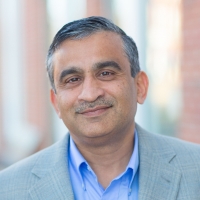
Madhav Marathe is an endowed Distinguished Professor in Biocomplexity, Director of the Network Systems Science and Advanced Computing (NSSAC) Division, Biocomplexity Institute and Initiative, and a tenured Professor of Computer Science at the University of Virginia (UVA). He is a passionate advocate and practitioner of transdisciplinary team science. During his 25-year professional career, he has established and led a number of large transdisciplinary projects and groups. His areas of expertise are network science, artificial intelligence, high performance computing, computational epidemiology and data analytics. Dr. Marathe has published more than 350 articles in peer reviewed journals, conferences and workshops. Mentoring and training next generation scientists has been his life-long passion.
Dr. Marthe earned his B.Tech in computer science and engineering from the Indian Institute of Technology Madras, his Ph.D. in computer science from University of Albany, SUNY. Before joining UVA, he held positions at Virginia Tech and the Los Alamos National Laboratory.